


Matenadaran Serves as a Comprehensive Repository of Early Armenian Printed Books
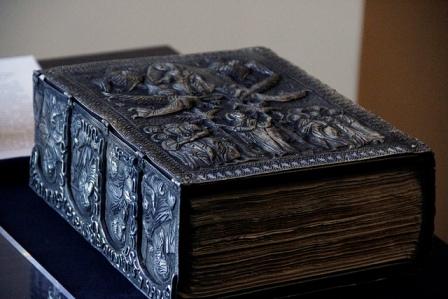
The collection of early printed books held at Matenadaran — the Mesrop Mashtots Institute of Ancient Manuscripts — comprises approximately 2,500 volumes, dated from 1512 to 1800. Of these, 95 titles are unique copies of early printed books. Many of the volumes, due to their physical appearance, decorative initials, marginal ornamentation, and printed and manuscript colophons, constitute a rich source of material for researchers working in the fields of bibliography and philology.
The collection contains bibliographically rare items of exceptional importance. Notably, it includes the first Armenian printed book, the Urbatagirk (“Friday Book”), produced in Venice in 1512 by Hakob Meghapart (Jacob the Sinner). Other significant works are the Tagaran (“Song book”) and the Aghtark (“Prayers for the sick and Horoscope”), both printed at the same press in 1513; the Parzatumar (“Calendar-based Manual”); the Saghmosaran (“Book of Psalms”) printed in 1565 by the scribe Abgar at his own press; and the first Armenian Bible, printed in Amsterdam in 1666 by Voskan Yerevantsi. Numerous other items of similar significance are also present. Also noteworthy is an incomplete copy of the Saghmosaran published in Venice in 1587 by Hovhannes Terzntsi. This copy, though lacking its title page and first gathering, remains one of the few surviving examples of this edition. The collection’s core holdings also include Francesco Rivola’s Armenian-Latin dictionary, Baŕgirk’ Hayots’ (“Dictionary of the Armenian Language”), published in Milan in 1621 and reissued in Paris in 1633, either entirely or largely unchanged. Other core items are the Plainer Explanation of Christian Doctrine, published in 1634 at the Roman Imperial Printing House, the Pataragatеtr (“Missal”), published in 1642 at the Urban press in Rome; the Kerakanutiun (“Grammar”), published by Voskan Yerevantsi in Amsterdam in 1666; the Saghmosaran editions printed in Venice in 1682 and 1684; and several other valuable works from the sixteenth and seventeenth centuries.