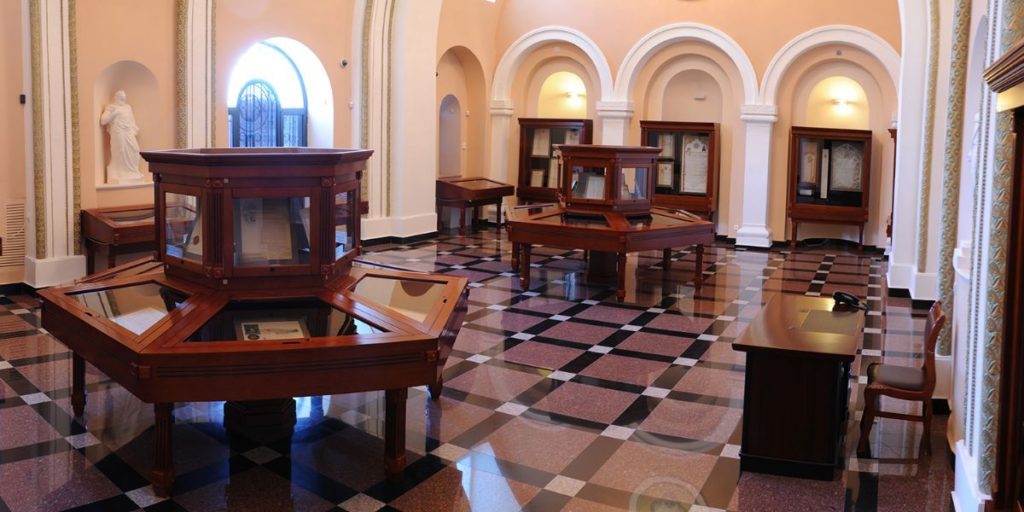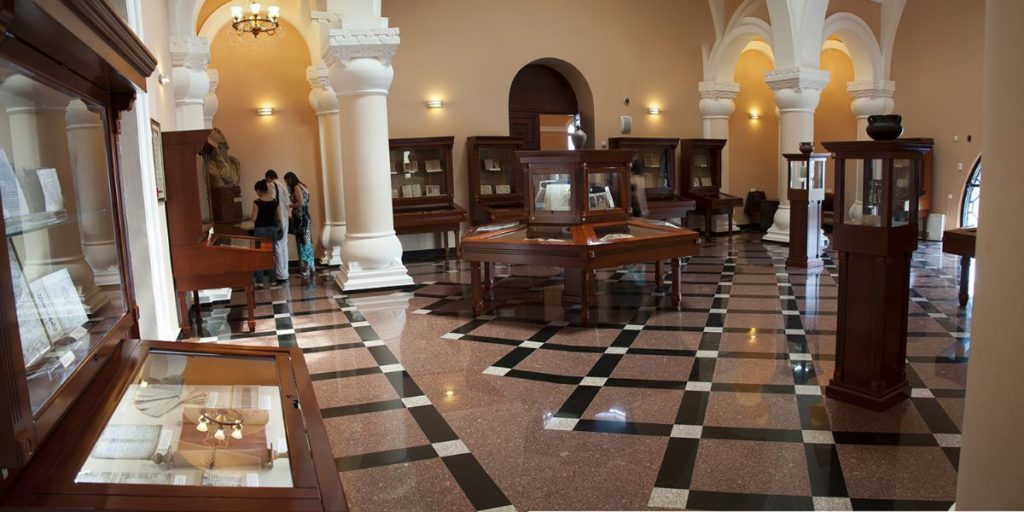
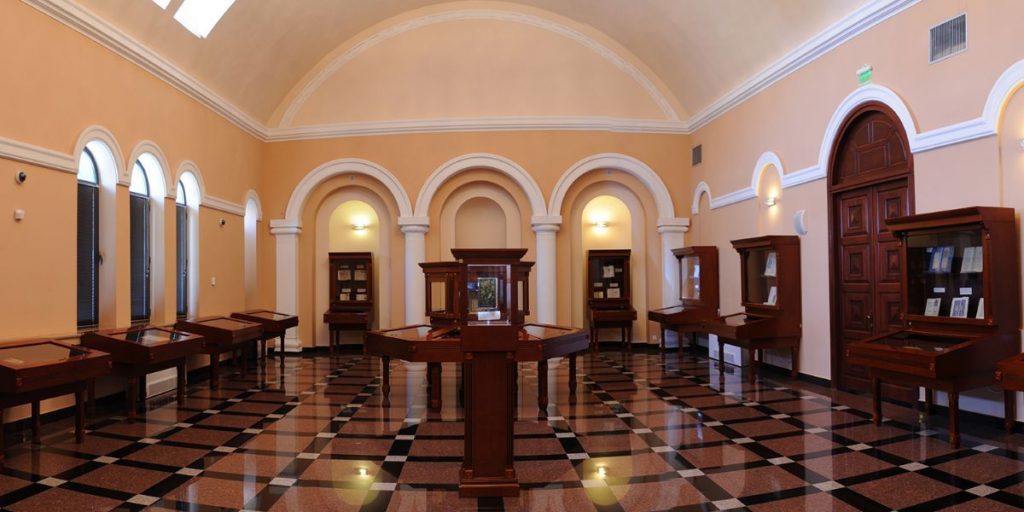
The museum of Mesrop Mashtots Matenadaran presents the history of Armenian manuscript culture and its development from the early medieval period through the modern era. The museum building was designed by architect Mark Grigoryan, constructed between 1945 and 1957, and draws architectural inspiration from Armenian medieval ecclesiastical architecture.
The forecourt and facade of the building feature sculptural installations depicting Mesrop Mashtots, the creator of the Armenian alphabet, alongside prominent figures of Armenian culture and written tradition. The sculptural ensemble serves as a symbolic representation of the history of thought, while the building itself acts as a kind of prologue, preparing the visitor for an encounter with a written culture that spans the depths of centuries.
The museum’s permanent exhibition traces the principal stages in the development of Armenian manuscript art. On display are religious, historiographical, medical, and philosophical works, as well as specimens of miniature painting and examples of medieval translated literature. The manuscripts are presented not merely as written sources but as singular artifacts of medieval art.
The artifacts also feature tactile display cases designed for visitors with visual impairments, offering an opportunity to gain an appreciation of the distinctive characteristics of medieval manuscript art.
Among the museum’s exhibition spaces, particular prominence is given to the Hall of Maps, where cartographic and geographical materials relating to the history of Armenia and the broader region are displayed across various historical periods of time.
Hall of Foreign-Language Manuscripts
This hall presents manuscripts in Arabic, Persian, Ancient Greek, Latin, Syriac, and other languages. The collection reflects Armenia’s historical role as a significant nexus of cultural and scholarly exchange. The materials on display bear witness to the scientific and cultural interactions that took place among diverse civilisations.
Laboratory: “Skills, Crafts, and Art of Medieval Armenia”
This space presents the material and technical dimensions of manuscript production. Visitors may acquaint themselves with methods of preparing medieval pigments, techniques of miniature painting, the process of parchment preparation, and the body of knowledge preserved within Armenian medical manuscripts. The laboratory demonstrates how science, art, and craft converged in the act of manuscript creation.
Educational and Cultural Hall
The Educational and Cultural Hall hosts lectures, meetings, exhibitions, and educational programs. The space is intended for schoolchildren, students, and researchers and contributes to the wider dissemination and public promotion of manuscript heritage.
Hall of Donation
Since 2023, one of the museum’s halls has been designated the “Hall of Donation.” This space hosts formal ceremonies for the presentation of manuscripts acquired through the “Homcoming of Manuscripts” campaign. The hall is also used for the organisation of temporary exhibitions, during which thematically curated materials from Matenadaran’s collections and newly acquired items are presented to the public.
Head of the Museum, Ph.D. in Arts, Yvette Tajarian +374 10 51 30 45
The museum is open from Tuesday to Saturday: 10:00-17:50
Sunday, Monday, holidays and remembrance days are free days.
The booking office is open from Tuesday to Saturday: 10:00-16:50. Tel: +374 10 51 30 14
Groups of more than five persons must arrange visits in advance. Tel: +374 10 56 25 78, +374 10 51 30 43